
Heritage & Deep History
Medieval ironworking. Georgian pleasure lake. A suspected multi-pond complex. Three distinct chapters of history written into the same water, the same dam, the same woodland.
Heritage in Brief
- A Wealden iron hammer pond — part of the network that once made England’s iron
- Hammer pond to pleasure lake — reshaped in the parkland era, never drained
- Notable trees — a mature estate lime and a living-fossil species in the grounds
- High Weald National Landscape — one of England’s best-preserved medieval landscapes
Wealden Iron. Georgian Parkland. Enduring Water.
The pond at Bay Pond Shaw is a hammer pond — one of a network of artificial water bodies created across the Weald of Kent and Sussex during the medieval and post-medieval period to power the bloomery forges and hammer mills of the Wealden iron industry.
When the iron industry declined in the eighteenth century, the pond did not fall into disuse. It was absorbed into the grounds of Field Green House — a mid-to-late Georgian house on Megrims Hill in Sandhurst, now Grade II* listed and described by Nikolaus Pevsner’s Buildings of England as “the grandest C18 house in Sandhurst” — and converted from an industrial water body into a pleasure lake. A boathouse was constructed on the water as part of the Georgian landscape design — recorded on historical maps, though no physical trace survives today. The pond that had powered iron production became a centrepiece of polite rural leisure for one of the most significant houses in the district.
This layering is unusual. Most former hammer ponds in the Weald were either abandoned, drained, or absorbed into agricultural land. Bay Pond Shaw was instead elevated — retained, reshaped, and given a new social purpose within a designed landscape. The water has been continuously managed and valued for over six centuries.
The name itself is a piece of history. The Ordnance Survey maps of the 1880s record the adjacent woodland as Coheybury Shaw — “shaw” being the Old English term for a small strip of woodland beside a field or water. Bay Pond Shaw combines the pond’s name with the woodland that has always flanked it. The estate name is, in that sense, several centuries old.

When the Weald Made England's Iron
From the late medieval period through to the eighteenth century, the Weald of Kent and Sussex was England's principal iron-producing region. The combination of iron ore in the clay, coppice woodland for charcoal, and fast-flowing gill streams that could be impounded as hammer ponds made the High Weald ideally suited to iron production.
Hammer ponds were created by constructing earthen dams across gill stream valleys. The impounded water was released in a controlled flow to drive a large water wheel, which in turn powered the heavy trip hammers used to shape and refine iron. The ponds required constant maintenance — regular dredging of accumulated silt, repair of the dam structure — and the hammermen who operated them were skilled engineers by the standards of their time.
When the Wealden iron industry collapsed in the eighteenth and nineteenth centuries — unable to compete with the coal-powered furnaces of the industrial Midlands — the ponds and their woodland were largely left in place. Some were converted to fishing ponds or ornamental water features. Many simply reverted to nature. Bay Pond Shaw's hammer pond is one of the well-preserved survivors of this industrial landscape.

Bay Pond Shaw in the Wealden Iron Network
Bay Pond Shaw’s hammer pond is one of dozens of surviving water management features that characterise the Wealden iron landscape of Kent and East Sussex. Within a ten-mile radius of the estate, documented ironworking sites include the hammer ponds at Hawkhurst, Sissinghurst, and Cranbrook — each part of the same dense industrial network that made the High Weald the engine of English iron production from the fourteenth to the eighteenth century.
The Weald produced cannon for the Tudor navy, ordnance for the Civil War, and the ironwork that underpinned the construction of much of Georgian London. Wealden iron went into the railings of St Paul’s Cathedral. The industry was not marginal or local — it was national in its significance and output. What remains of it in the landscape today — the ponds, the woodland, the earthworks — is the residue of an industrial economy as consequential, in its time, as anything the Industrial Revolution produced.
Bay Pond Shaw sits within this landscape — a small but authentic fragment of the physical record of that industry. The dam holds water today for the same reason it was built: because water, properly managed, produces something valuable. The purpose has changed. The pond has not.
From Hammer Pond to Pleasure Lake
When the Wealden iron industry collapsed in the eighteenth century, most of its hammer ponds were abandoned or drained. Bay Pond Shaw followed a different course. The water body was absorbed into the grounds of Field Green House — a mid-to-late Georgian house on Megrims Hill, Sandhurst — and deliberately redesigned as a pleasure lake within a designed landscape setting. Field Green House is now Grade II* listed (List Entry 1204749, first listed 1967): the second-highest category of listed building in England, given to fewer than six percent of designated structures. It is described by Pevsner’s Buildings of England: West Kent and the Weald as “the grandest C18 house in Sandhurst.”
A boathouse was constructed on the water as part of this Georgian intervention — its position is recorded on historical maps of the period, though no physical structure survives today. The lake that had existed for centuries as a piece of industrial infrastructure — functional, managed, economically necessary — became an object of leisure and aesthetic appreciation for one of the most significant households in the High Weald. This transition speaks directly to Georgian sensibilities: the fashionable reordering of productive landscape into picturesque scenery, the conversion of utility into beauty.
The depth of that history is legible in the water today. The dam, the inlet, the basic geometry of the lake basin — all are medieval in origin. The pleasure lake that Field Green House created was built on and around that medieval structure. The conservation estate that exists now was built on that. Three distinct purposes. One continuous body of water.
A Mature Lime and a Living Fossil
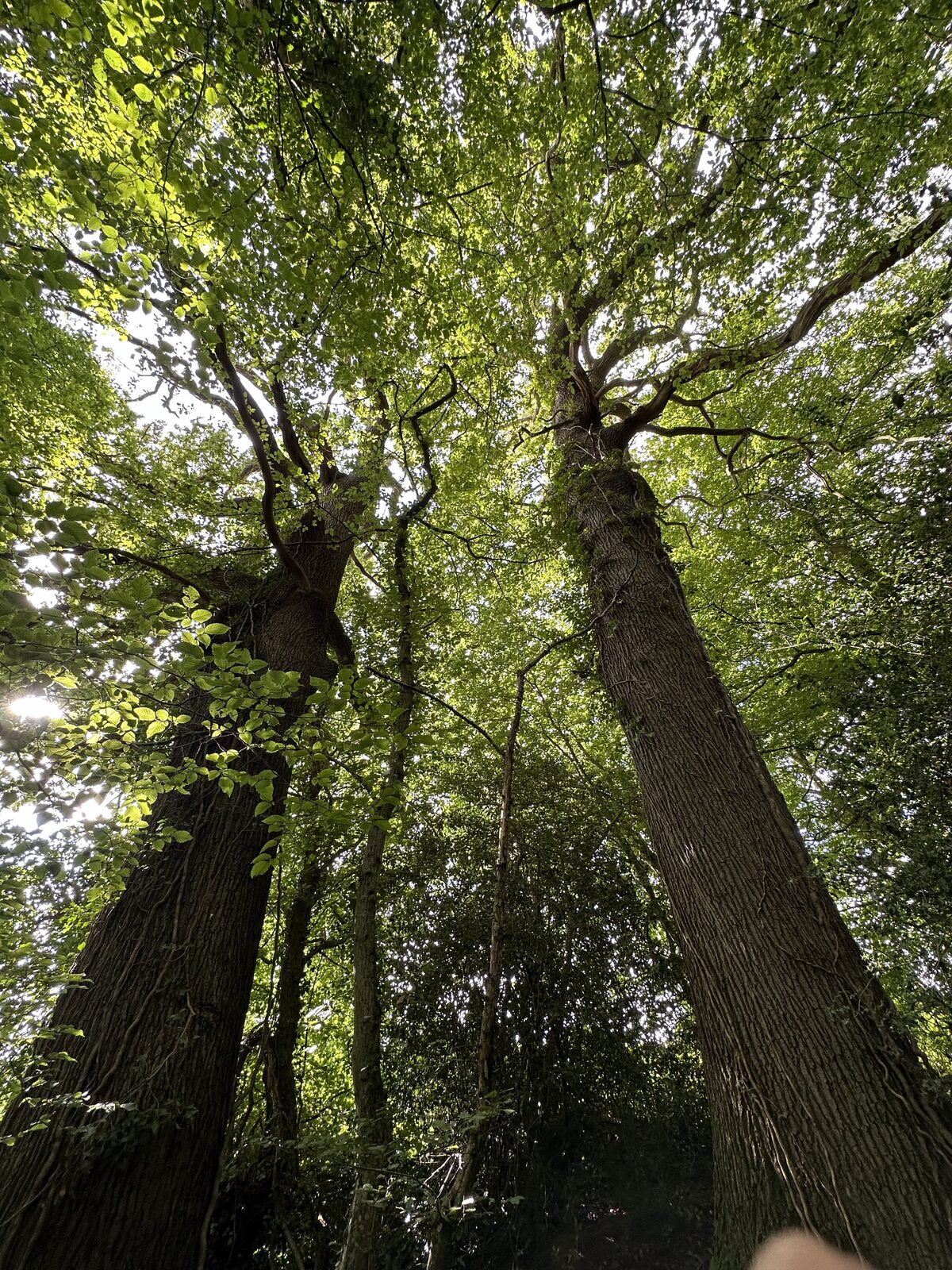
Beyond the ancient woodland canopy, the estate holds two tree species of particular note. A mature lime stands within the grounds — a species closely associated with old estates, parkland, and medieval settlement edges in the High Weald.
The estate also holds a stand of dawn redwoods (Metasequoia glyptostroboides) — a species unknown to Western science until 1944, when living specimens were discovered in a remote valley in Sichuan, China. Previously known only from the fossil record, it had been assumed extinct for millions of years. Specimens planted in English estates from the mid-twentieth century are now among the oldest outside their native range. The presence of dawn redwoods at Bay Pond Shaw places the estate in quiet but remarkable botanical company.
The Estate in Time
The gill stream valley is dammed to create the hammer pond that now forms the centrepiece of Bay Pond Shaw, part of the medieval and post-medieval Wealden iron landscape. Water impounds behind the earthen dam structure.
The Wealden iron industry declines as coal-powered furnaces in the Midlands undercut Weald production. The hammer pond — rather than falling derelict — is absorbed into the grounds of Fieldgreen House.
The former hammer pond is absorbed into the grounds of Field Green House — a mid-to-late C18 house on Megrims Hill, Sandhurst, now Grade II* listed and described as “the grandest C18 house in Sandhurst” (Pevsner). A boathouse is constructed on the water — recorded on historical maps, no longer surviving. The pond transitions from industrial infrastructure to Georgian pleasure lake — an unusual elevation for a former Wealden iron working water body.
Bay Pond Shaw is understood to have passed into private ownership around this period, beginning a long tradition of stewardship rather than agricultural production — managed for the preservation of its natural character: its woodland, its water, and its quiet. The ecology-first philosophy that guides the estate today — no industrial inputs, no commercial compromise — reflects that same long-held approach.
The estate is managed under a contemporary ecology-first protocol, with conservation outcomes governing all land management decisions. The hammer pond continues to function as the hydrological centrepiece of the estate.
The Landscape May Hold More Than One Pond
The single surviving hammer pond at Bay Pond Shaw may not be the whole story. The evidence — topographic and on the ground — raises a question that has not yet been formally answered: was this valley once the site of a more extensive ironworking water system, possibly comprising two or even three ponds in sequence along the same gill stream?
The LiDAR Evidence
Environment Agency LiDAR terrain modelling of the valley reveals earthwork features — linear raised profiles and subtle basin depressions — consistent with former dam structures and silted pond basins. These features do not correspond to any modern field boundary or agricultural earthwork. They follow the valley floor in the pattern characteristic of managed water systems.
The Historical Pattern
Wealden ironworking complexes routinely comprised multiple ponds in series — a head pond for storage, a hammer pond for power generation, sometimes a tail pond below. Several documented sites in Kent and Sussex show exactly this configuration along gill stream valleys of the same type and scale as the watercourse at Bay Pond Shaw. A three-pond complex here would be entirely consistent with the regional pattern.
The Open Question
None of this is established fact. The LiDAR features require ground-truthing. The hypothesis of a multi-pond complex at Bay Pond Shaw is plausible, consistent with the available evidence, and — as yet — formally uninvestigated. Bay Pond Shaw is actively seeking to commission a proper desk-based archaeological assessment and geophysical survey of the valley, in collaboration with the High Weald National Landscape and relevant heritage bodies. Until that work is done, the question remains open. Which is, in its own way, part of what makes this place what it is.
The High Weald National Landscape
Bay Pond Shaw sits within the High Weald National Landscape — one of England's largest and most ecologically significant protected landscape designations. The High Weald is recognised for the exceptional quality and intactness of its medieval landscape character: the ancient woodland, the hammer ponds, the gill streams, the sunken lanes, and the dispersed settlement pattern that together constitute a landscape of genuine historical and ecological rarity.
The National Landscape designation places specific obligations on land management within the High Weald — obligations that Bay Pond Shaw meets and, in many respects, exceeds. The estate is managed not merely in compliance with its landscape designation but in active service of it.
The High Weald National Landscape is one of the oldest continuously farmed landscapes in England. Bay Pond Shaw occupies a small but significant piece of that landscape — one managed with the long view in mind.
“The land carries its history without announcement. The pond, the dam, the woodland — they are the record. And some of the record has not yet been read.”Bay Pond Shaw — Heritage Statement
Heritage Enquiries
For enquiries regarding the estate's historical record, the ongoing hammer pond complex research, research access, or heritage partnership opportunities, please contact us directly.
Contact the Estate